January 2026. Chicago. 06:14.
I am at my post. The north-facing kitchen windowsill is cold against my paws. Colder on the left side where the draft comes through. I do not move. From up here, four stories above the street, city sprawled below, I can see everything. Rooftops. Bare yards. The orange glow of the city doing whatever it does when sensible creatures are asleep.
Except for them.
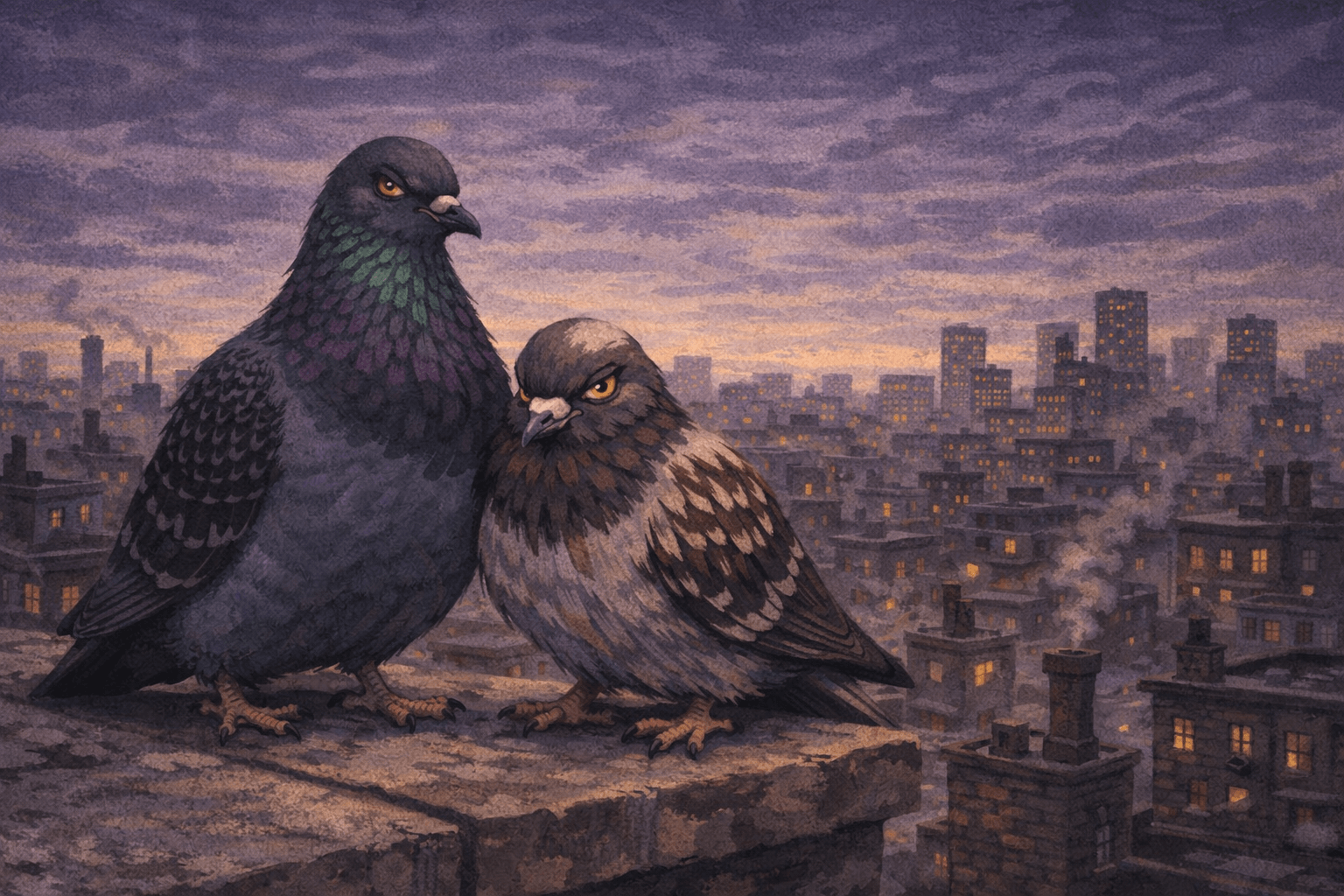
They are on the Kowalski building tonight. Third chimney from the left. Two gray shapes hunched against the cold, feathers puffed, looking smug in the way that only pigeons and career criminals can look smug. They know I can see them. They always know.
I press my nose to the glass. The glass does not care. It fogs where my breath hits it. Clears. Gerald is still there.
The dooob fountain sounds like a running creek behind me. Low water. I note this. I do not move to alert anyone. The surveillance continues.
It was not always like this. Let me take you back. Back to before I knew their names. Back to before I understood what we were to each other. Back to the spring of 2025. April. When two pigeons made the worst decision of their small, seed-addled lives.
April 2025: The Arrival
It started the way most things start in Chicago: quietly, and then all at once.
The windows were open for the first time that year. We had been in this apartment for over a year by then. (March 2024. The move. Stressful. New smells. Smaller space. One floor instead of multiple.) I had claimed the north and west facing kitchen windows as my surveillance post. Established territory. I know every rooftop. Every chimney. Every flight path through my airspace.
The mesh had replaced the glass. April warmth. I had full access again. Olfactory. Audio. Visual. This is how surveillance is meant to function.
I resumed my full duties: nose to the mesh, ears tracking every sparrow, every siren, every pigeon that passed through. Old shelter habits. (Fifty cats in that shelter. I was two years old when they chose me. Not a kitten. Harder to place. I learned to watch. I learned to catalogue. I learned who got fed first and who waited.) Those habits do not die. They adapt.
One morning in late April 2025, I noticed two pigeons circling the building across the way. Not passing through. Circling. Assessing. I watched them with the professional attention of someone who has spent considerable time watching things that do not know they are being watched. They settled near the roofline. They lingered. One of them, the larger one with an iridescent neck patch that caught the light like an oil slick, strutted along the edge of the parapet as if he owned it.
He did not own it.
Within a week, they had chosen a nesting spot near our building's roof. Within two weeks, there were structural implications. I do not mean that architecturally. I mean that they had decided this was their neighborhood now. My neighborhood. The one I had been monitoring for over a year. And that decision would haunt all of us.
The Naming of the Enemy
A proper adversary deserves a proper name. I gave them each one.
The larger bird, the one with the iridescent neck ring who strolls around like a landlord doing a property inspection, I named Gerald Neckring. Gerald has the energy of someone who has never once considered that his behavior might be unwelcome. He lands on things. He struts across things. He regards the world with the blank confidence of a creature who has never, not once, experienced consequences.
I find him deeply offensive.
Gerald is missing toes on his left foot. I have noted the slight limp. The way he compensates. This is not a young pigeon making his first territorial claim. This is a pigeon who has paid prices before. Who has squared old debts. Who has survived something and decided he earned the right to be here.
He has not earned it.
His companion is smaller, scrappier, with an asymmetrical splotch of brown across his left wing that looks like a paint accident. I named him The Splotch. The Splotch is not the brains of this operation. (That would be Gerald. Unfortunately.) The Splotch is the chaos element. The muscle. He takes risks. He miscalculates landings. I have seen him hit his head on the AC unit. Twice. He appears not to learn from this.
On one particular afternoon last July, The Splotch landed directly on my windowsill. My windowsill. The outside part of it. With nothing between us but the mesh. We looked at each other for a long moment. The kitchen was quiet. The radiator had not yet started its afternoon cycle. Just us. Just that moment.
He cooed.
He cooed at me.
I have not forgiven this.
The Escalation
By summer 2025, the situation had deteriorated to the point where even the humans noticed. The mess was considerable. Pigeons, I have learned, treat all surfaces as equally valid facilities, and they have an almost artistic commitment to coverage. Our building's ledges. The neighbor's AC unit. A stretch of railing that used to be perfectly fine. All casualties.
I heard the humans complaining about it one morning in August. Dad was making coffee. Mom was at her work table in the sunroom. “Those pigeons,” they said, in the tone of people who have just discovered something I have been documenting for months. Welcome to the investigation. I have notes. Extensive notes.
Gerald and The Splotch became bolder as the summer went on. They would perch closer and closer to the window. Gerald once stood on the air conditioning unit outside for eleven minutes. Doing absolutely nothing. I timed it. Just existing. Loudly. Pointedly. He knew I was there. He knew I was watching. The mesh separated us. He did not care.
I began keeping a formal log. Date. Time. Location. Behavior. Duration. Cosmo asked what I was doing one afternoon when he came to the window. I said I was “resting with intention.” He accepted this. Cosmo accepts many things.
November 2025: The Torture of Glass
And then November came. The windows closed.
This is the particular cruelty of winter surveillance in Chicago: I can still see them. The glass does not stop the seeing. It just stops everything else. I can watch Gerald strut across the rooftop of the building to the west. I can watch The Splotch land on the ledge three feet below my windowsill. I can observe their continued, infuriating existence in full detail.
I just cannot smell them. I cannot hear them. I cannot make my presence felt.
There is a specific kind of frustration in watching through glass. You press your nose to it and the cold comes through. Your breath fogs up the surface. The lower three inches of the window fog when the temperature drops below freezing. For one moment, mercifully, you cannot see them. And then the fog clears. And there they are again. Entirely unbothered.
Some nights they land directly on the windowsill. My windowsill. The outside part of it, which used to be a neutral zone and is now, apparently, their territory too. Gerald will sit there and preen. The Splotch will sit there and look around with that expression pigeons have, which is no expression at all, which is somehow worse than any expression.
And I sit on the inside. Four inches of cold air and two sheets of glass between us. The windowsill cold against my paws. The draft from the left side. The fountain gurgling behind me because Dad has not refilled it yet. And I watch.
I watch. I wait. I remember everything.
From this window, I have catalogued the movements of twelve squirrels, thirty-seven sparrows, four doves, one raccoon of questionable judgment, and two specific pigeons who have made a catastrophic miscalculation about what this neighborhood is and who it belongs to.
Spring Is Coming
But here is what Gerald Neckring and The Splotch do not know, because pigeons do not know things: winter ends.
I have seen winters before. (The shelter had winters. Cold. The building was old. The heat was inconsistent. You learned which spots stayed warm.) I know exactly what happens when the temperature climbs back above fifty degrees. I know the sound the window makes when the humans finally push it open. I know the particular quality of the air that comes through the screen: the smell of wet concrete and someone grilling somewhere and the city waking back up.
And I know that the mesh, while humbling, is not nothing. From behind it, I am present. I am audible. I am, most importantly, visible in a way that matters.
Spring is coming. March. April. The windows will open again. And when they do, Gerald and The Splotch will return to my windowsill the same way they always do. Without invitation. Without apology. Without the slightest awareness that the strategic situation has changed.
They do not know what is waiting for them.
I have been documenting for ten months. I know their routines. I know Gerald’s limp. I know The Splotch’s poor landing calculations. I know which chimney they prefer and what time they return and how long they stay.
They will learn not to cross me.
They will.
Gigi
Written at 06:14
Currently: Still at the window. They have not moved. Neither have I.